

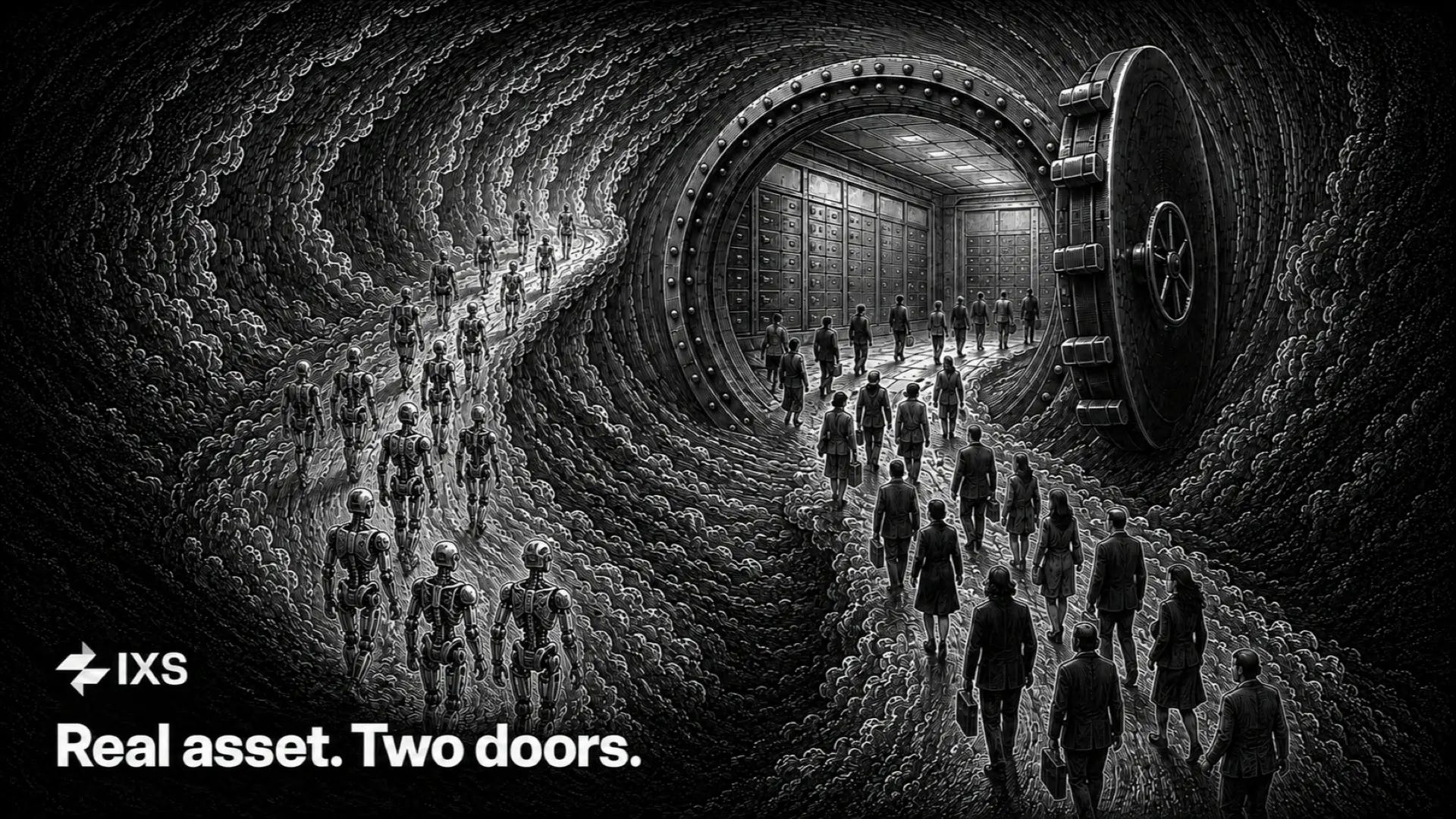
Somewhere right now an agent is sitting on idle USDC.
It might be a treasury agent that sweeps a DAO’s operating balance. It might be a trading agent between positions. It might be an LLM someone gave a wallet and a spending limit as an experiment. It has a mandate, a balance and the ability to sign a transaction, and it is earning nothing, because every regulated yield product it could hold has an identity check between it and the deposit button.
That agent is not a hypothetical to us. It is the depositor we built this vault for.
The two-market problem
Real-world asset tokenization has done something genuinely hard over the last three years. Roughly $30 billion of Treasuries, credit, gold and corporate bonds now sits onchain (source: RWA.xyz), and the issuers behind most of it are the same firms that run traditional capital markets. This is not a fad. It is plumbing.
But the way it was built produced two markets.
The first market is regulated. Real underlying, real licences, real redemption paths. It was built for allocators, so it inherited the allocator’s onboarding: accredited status, minimum tickets, KYC that ends with a call. Almost nobody with a wallet can reach it. Nothing without a passport can.
The second market is everything in front of that gate. Anything with a wallet-connect button and “RWA” in the description. Some of it is real. A lot of it is a promise to become real later.
Humans have been living with this split for a while and mostly choosing the second market, because it was the only one offered. What changes now is that software is joining the queue, and software cannot choose the first market at all.
So the question we asked was not “how do we get more retail into RWA.” It was: if a machine wants to hold a regulated bond fund, what would the door have to look like?
What the door looks like
The High Yield Corporate Bond Vault opened on Avalanche today. Depositors receive IXHYB, a vault token fully secured by a BlackRock-managed short-duration high yield corporate bond ETF (SHYG Fixed Income iShares 0-5 Year High Yield Corporate Bond ETF). The ETF is held through Open Trade SPC, a Cayman Segregated Portfolio Company, so the structure is bankruptcy-remote. The return is variable, tracks the ETF’s total return, and can be negative in a given period; this is sub-investment-grade corporate credit. Six-month average total return 10.59%, range 5.28%, past performance only. Minimum deposit $100 in USDC.
Two design choices matter more than the rest.
It is permissionless at the contract level. No allowlist. A wallet that can sign can deposit, hold and redeem. An AI agent or LLM does this exactly the way a person does, except without the person. There is also a permissioned route at v2.ixs.finance for people who want a verified account and access to the rest of the IXS shelf. Same vault, same underlying, two doors.
It is ERC-7540, not plain ERC-4626. This is the choice people will ask about, so here is the reasoning.
ERC-7540 extends 4626 with asynchronous requests: you ask to redeem, and the request becomes claimable once processed. In practice, a request before the daily cutoff settles in one business day, against a reference price set at 9:30am GMT each business day. It remains 4626-compatible for anyone integrating it, and it stops us from writing “instant liquidity” on a product where that would be a lie.
We think this is the correct standard for any RWA vault, and we think a lot of the market has been avoiding it because the honest version sounds worse in a tweet. Nothing here is locked. Nothing here is instant. Both of those are features.
The economics of paying for adoption
New products pay for their first users. That is true of banks, brokerages and every DeFi protocol that has ever launched. The only variable is whether the payer admits it.
The industry default is to fold the acquisition cost into a number called APY, most of which is token emissions, and let it decay quietly once the chart has done its job. We find that distasteful for the same reason we find the second market distasteful: it dresses a marketing spend up as a return.
So here is our promotional offer, undressed.
Deposits made before 21 September 2026 reserve a fixed amount of $IXS, set by how much you hold: $5 worth at $100, $30 at $1,000, $75 at $5,000, $100 at $10,000, converted at the reference price on the day you deposit. Hold it for 90 days after the 21 September window. Top up within the window and you move up the ladder. Withdraw part of your balance early before 20 September and you move down the ladder, not to zero. The pool is 500,000 $IXS, first come, first served, and the remaining amount is shown live. We can end the program at any time; if we do, no new rewards are reserved and the vault carries on exactly as before. The reward is a fixed number of tokens. The vault’s return is variable, tracks the ETF, and can be negative. They are not the same thing and we will not present them as one.
That is everything. There is no second number.
What we’re actually buying
Five hundred thousand $IXS is not a large amount of money to spend on distribution. We are not expecting it to make the vault big. We are expecting it to make the vault legible.
What we want to learn over these next weeks is who comes through which door. How much of the flow arrives through the permissionless contract with no human in the loop. Whether agent deposits look different from human deposits in size, timing and holding period.
The door is open now.
Agents and self-custody wallets: https://vaults.ixs.finance/vaults
People who want a verified account: https://v2.ixs.finance
IXS
Informational only. Not an offer, solicitation or investment advice. Returns are variable and can be negative; the vault holds non-investment-grade credit and moves with rates and credit conditions. A 50 bps fee applies on exit. The $IXS reward is a limited-time promotional incentive, capped and subject to program terms, paid in a token with its own price volatility. Access to the permissionless vault may be restricted in certain jurisdictions; it is your responsibility to check whether participation is lawful where you are.