

On July 9, an AI agent deposited USDC into a vault on BNB Chain and earned yield sourced from institutional real-world assets. No human signed the transaction. The contract was public and verifiable before the first dollar moved. That is the whole story, and it is a bigger one than it sounds.
Start with what did not work.
For the last cycle, “AI plus crypto” mostly meant a chatbot that could quote a token price. It was a demo, not a product. The interesting version was always the one nobody could ship: an agent that holds its own wallet, moves real money, and puts idle capital to work on its own once a human sets the rules. An agent that has to wake a person to approve every deployment is not autonomous. It is a chatbot with a few extra steps and a worse interface.
The reason that version stayed a demo is not a model problem. It is an access problem.
The gap
Onchain RWA yield is now a multi-billion-dollar market. Treasuries, money market funds, private credit, corporate bonds, all of it wrapped onchain and paying real returns. And almost all of it sits behind KYC, allow-lists, and qualified-investor onboarding.
Those gates are not a bug. They are how regulated yield stays regulated. But they were designed for humans clicking through an onboarding flow. An autonomous agent cannot present a passport, pass an accreditation check, or wait three days for a compliance review. So the one allocator that never sleeps, never misses a rebalance, and can act the moment its policy says to has been standing outside the best yield onchain with no way in.
Two kinds of infrastructure existed. The kind institutions trust, and the kind agents can use. They were not the same kind. Closing that distance is the actual work.
What we did
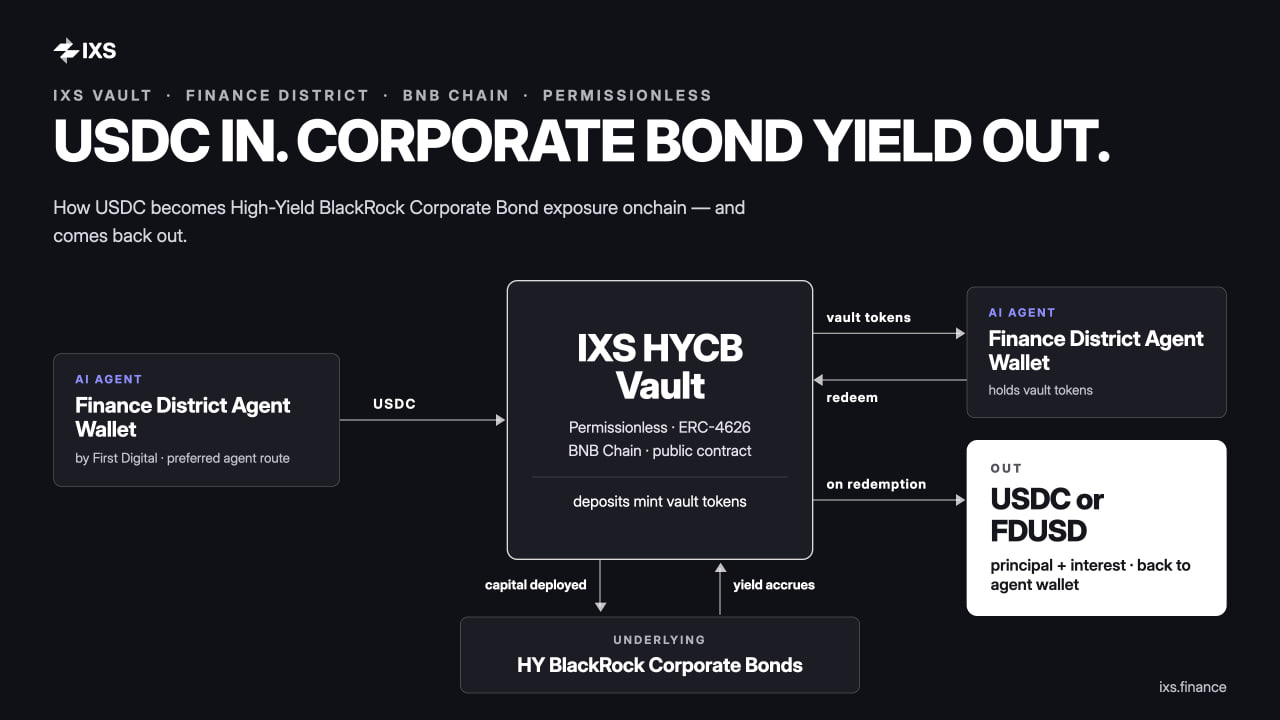
The IXS Agentic Vault is the bridge, and the order it was built in is the point.
The yield comes first, and it comes from real assets. Institutional real-world assets, under DARE-licensed (Bahamas) onchain issuance, not token emissions dressed up as returns. That foundation is what an institution can underwrite and what makes the number durable.
The agent-addressable layer sits on top of that foundation, not in place of it. Access runs through the Finance District Agent Wallet. Every user gets EVM, Solana, and Bitcoin wallets at signup. Private keys live inside a Trusted Execution Environment. The setup is non-custodial, so the operator keeps ultimate control. Any agent that speaks MCP can speak to the wallet, and through it to the vault. Claude, ChatGPT, Cursor, Codex, or a stack your team is building from scratch. IXS APIs are x402-compatible, so the agent pays per call in stablecoins, the same way it pays for any other service.
The human still sets the policy. The agent executes inside it. That division is not a limitation. It is the design.
The contract is public and verifiable from day one: 0xc975a3EeF2e49F8eDdEf585340C43f15300fCB82 - accessible here: https://vaults.ixs.finance/vaults. You read it before you trust it.
What comes next
The vault takes USDC today. First Digital is the launch partner, and FDUSD follows. More stablecoins after that. It runs on BNB Chain first, with more chains to come.
Why this is the wedge
The intersection of real-world assets and autonomous agents is where a large share of onchain capital is going to be allocated over the next few years. Most RWA platforms are not building for it. They are competing on yield numbers and distribution deals, which is a fine business and a crowded one.
We think the durable position is elsewhere. The platforms that win the agent era will not be the ones with the loudest APY. They will be the ones whose regulated foundation an institution can underwrite and an agent can actually transact through, at the same time, without one breaking the other. That is a narrow piece of ground. We are claiming it.
If you are building an agent that needs somewhere real to earn, the vault is open.
How to get started
Choose an installation method for the Finance District Agent Wallet:
AI Assistant: Use the conversational interface for non-technical users (https://fd.xyz/fd-agentwallet)
MCP server: Use this for any MCP-compatible client like Claude, Cursor, Codex, or ChatGPT.
CLI: Use this for terminal and server workflows.
Review the documentation: Consult the quickstart and overview guides at https://fd.xyz/ecosystem/wallet, https://developers.fd.xyz/agent-wallet/quickstart, and https://developers.fd.xyz/agent-wallet/overview.
Configure your agent: Read the contract at https://vaults.ixs.finance/vaults, point your agent at it, and set your policy.